|
Bob and Camille had been participating
in a Zero Waste Challenge instigated by Shaun Stenshol,
president of Maui Recycling Service. “We had been
talking about a ‘Plastic Free Month’ and I
thought, ‘Why not take it a step further and aim for a
Waste-Free month?” Shaun explained. Both households
were already composting all their food waste and recycling
most of their other trash. Read the whole story below:
The Zero Waste
Challenge.
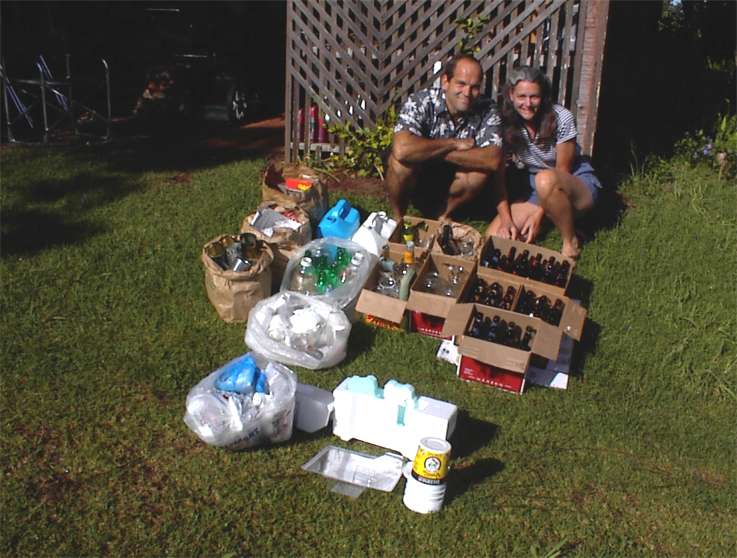
Bob and Camille with their 4 pounds of
trash (in front) and 86 pounds of recyclables from April.
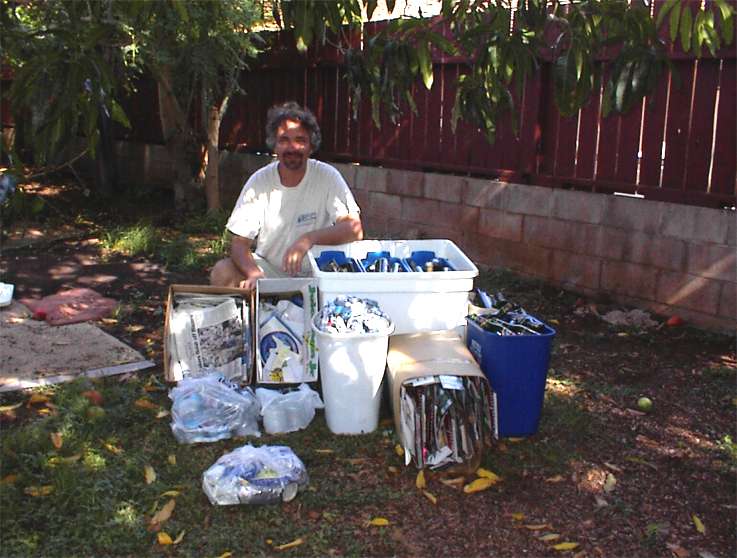
Shaun Stenshol, Zero Waste Challenge winner with his tiny,
one-pound bag of trash in front and 99 pounds of
recyclables. (Although for two people to have almost as
little trash/recyclables as one person is actually more
impressive! pm)
The Armantrouts had been participating
in a Zero Waste Challenge instigated by Shaun Stenshol,
president of Maui Recycling Service. “We had been
talking about a ‘Plastic Free Month’ and I
thought, ‘Why not take it a step further and aim for a
Waste-Free month?” Shaun explained. Both households
were already composting all their food waste and recycling
most of their other trash.
Zero Waste really means Zero Landfill.
According to the Grass Roots Recycling Network, “Zero
Waste maximizes recycling, minimizes waste, reduces
consumption and ensures that products are made to be reused,
repaired or recycled back into nature or the
marketplace.” Shaun, Bob and Camille would love to see
Maui join Australia, New Zealand, and Toronto in their
commitment to achieving Zero Waste.
Bob stressed the importance of
sustainability. The goal of this experiment was to produce
new practices for both households as opposed to winning the
challenge one month for the smallest amount of trash. They
couldn't cheat by eating out because they had agreed to
bring home all disposable containers from outside meals. The
changes they made this month would have to be changes they
could sustain over time. Suppressing consumption for one
month would have been wrong because it would have caught up
with them in another month.
That’s why Bob went ahead and
bought a new scanner in April. “I thought about waiting
until after the challenge, but decided to go ahead and get
it.” He said. When he got the scanner home, Bob
discovered that it was packaged with two blocks of Styrofoam
which could not be recycled or composted. This Styrofoam
doubled their contribution to the landfill. Bob plans to
contact Hewlett Packard and encourage them to use recyclable
packaging in the future.
At the end of the month, the
Armantrouts had generated 86 pounds or 7.4 cubic feet of
waste that couldn’t be composted. “Imagine if we
had to bury this in our front yard every month!” Said
Camille. Fortunately, they will be able to recycle all but 4
of those 86 pounds. Four pounds for two people sounds pretty
good, but Shaun won the challenge. His total came to 100
pounds, but only 1 pound of that will end up in the
landfill. He recycled 99% compared to our 95.4% of total
generated waste stream by weight. These figures would be
much different if both households hadn’t composted all
food waste and paper products.
This exercise allowed them to pinpoint
stress points in their personal waste disposal system. The
big offenders were beer bottles and non-recyclable plastic.
“Even though the beer bottles are recyclable they
constituted 35% of our waste stream by weight.” Camille
explained, “Nearly all of what we sent to the landfill
was non-recyclable plastic such as dairy containers and
Styrofoam.”
Above written by: Camille
Armantrout, friend and recycler extraordinaire...
We want YOU to try your own
ZERO
WASTE CHALLENGE...
Challenge a friend, or just by yourself...
Keep track of what you get rid
of....
whether its recycleable or not...
Then, if you can, find ways to live without that item,
or, at least, find a substitute that is recyclable or
reusable...
Even though recycling is a great thing...
Recycling often takes a lot of energy, as in fossil fuels,
to ship those items back and forth,
and create and recreate them into something else.
The best thing to do, for the planet and the future, is to
have NO waste and NOTHING to recycle!
What can you do without?
Live local.... Only buy things produced within 50-100
miles...
Only buy things that can be reused or recycled...
I challenge you....
Let us know what you find
out...
|